Books
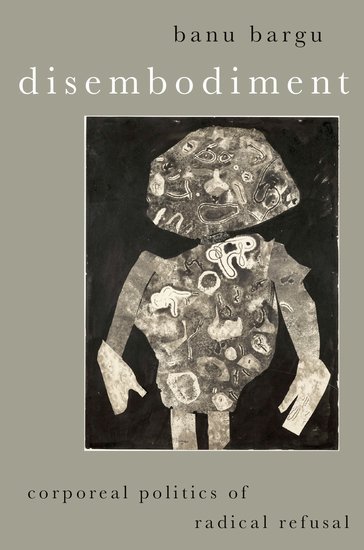
Disembodiment:
Corporeal Politics of Radical Refusal
Disembodiment examines self-destruction, self-injury, and radical self-endangerment as unconventional performances of refusal that are erased, marginalized, and distorted by metanarratives of history as progress and agency as freedom. From the death-acts of enslaved Africans, hunger strikes of woman suffragists, and Gandhian fasting practices to the self-incineration of Bouazizi, hunger and thirst strikes in the Maze and Guantánamo, and lip-sewing practices of migrants and asylum seekers at the borders of the Global North today, Bargu traces a bleak repertoire of contention performed by the oppressed. As a work in global critical theory whose normative compass is the suffering body, Disembodiment brings together corporeal enactments of defiance from the Global South with major thinkers of Western modernity and prominent critical-theoretical traditions of the twentieth century. Disembodiment offers a materialist theory of corporeal agency that unfolds a stark critique of the present and upholds the body’s powers as fundamentally rebellious and ultimately undomesticable.
Disembodiment is the co-recipient of the 2025 David Easton Award, given by the American Political Science Association Foundations of Political Theory Section. This award is given to a book that broadens the horizons of contemporary political science by engaging issues of philosophical significance in political life through any of a variety of approaches in the social sciences and humanities.
Disembodiment is also the recipient of the 2026 Lee Ann Fujii Book Award given by the International Studies Association. This award was established to recognize the best book published in the previous two calendar years that significantly advances issues of diversity in the discipline, whether through topical focus or authorship. In this vein, the award gives preference to scholars from underrepresented communities in IR: scholars from the Global South, LGBTQ scholars, and women. The award is co-sponsored by the International Studies Association Northeast Chapter, the LGBTQA Caucus, the Women's Caucus, the Committee on Diversity and Representation, the Global South Caucus, and the Committee on the Status of the Global South.
Disembodiment has also been recognized by an Honorable Mention for the 2026 Sai Felicia Hensel Best Book Award from the Interdisciplinary Studies Section of the International Studies Association, which recognizes a work that is an original and outstanding contribution to interdisciplinary studies, broadly defined.
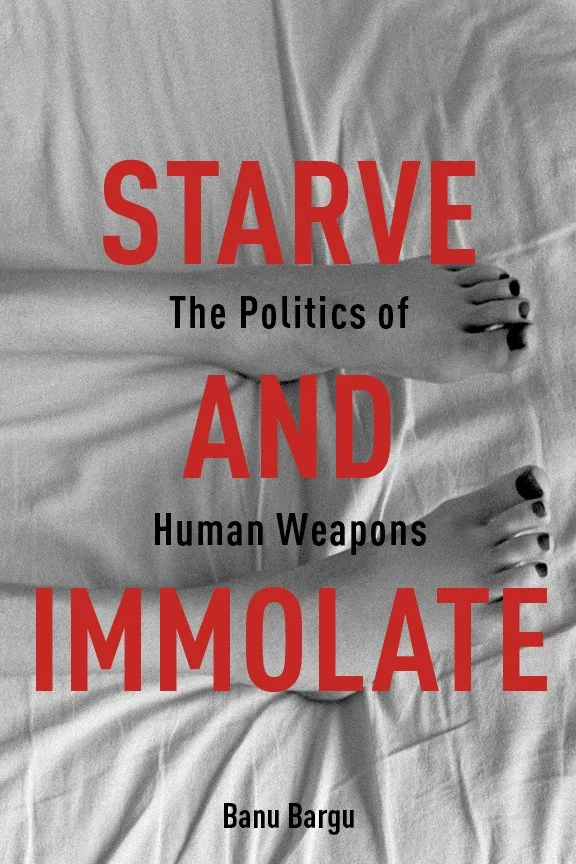
Starve and Immolate:
The Politics of Human Weapons
Starve and Immolate tells the story of leftist political prisoners in Turkey who waged a deadly struggle against the introduction of high security prisons by forging their lives into weapons. Weaving together contemporary and critical political theory with political ethnography, Banu Bargu analyzes the death fast struggle as an exemplary though not exceptional instance of self-destructive practices that are a consequence of, retort to, and refusal of the increasingly biopolitical forms of sovereign power deployed around the globe. Bargu chronicles the experiences, rituals, values, beliefs, ideological self-representations, and contentions of the protestors who fought cellular confinement against the background of the history of Turkish democracy and the treatment of dissent in a country where prisons have become sites of political confrontation. A critical response to Michel Foucault's Discipline and Punish, Starve and Immolate centers on new forms of struggle that arise from the asymmetric antagonism between the state and its contestants in the contemporary prison. Bargu ultimately positions the weaponization of life as a bleak, violent, and ambivalent form of insurgent politics that seeks to wrench the power of life and death away from the modern state on corporeal grounds and in increasingly theologized forms. Drawing attention to the existential commitment, sacrificial morality, and militant martyrdom that transforms these struggles into a complex amalgam of resistance, Bargu explores the global ramifications of human weapons' practices of resistance, their possibilities and limitations.
Starve and Immolate was the recipient of the 2015 First Book Award, given byAmerican Political Science Association Foundations of Political Theory Section.
Starve and Immolate was also recognized as a 2015 Choice Outstanding Academic Title by the Association of College & Research Libraries (ACRL)/American Library Association.